How long does a jiu jitsu match last?
BJJ STATISTICS
Assuming we mean in the context of a BJJ competition, and because a match can end early due to a submission, there are two ways to answer this question: how long is a regulation match, and how long do matches actually last?
How long is a regulation BJJ match?
As with most things, it depends.
In most amateur BJJ competitions, match length will depend on your age and ability/experience, as well as the promotion. For NAGA, white belt matches in gi and novice/beginner matches in no-gi are a max of 4 minutes long. Blue belt and intermediate matches are 5 minutes, and purple belt and up are 6 minutes. In Grappling Industries tournaments, all adult matches are 5 minutes.
How long do matches actually last?
The cool thing about BJJ matches is that they have an alternate win condition: no matter what the score is, you can always get a submission and win, and the match is over.
Going back to the big data analysis I did (over 65,000 matches), I took a look at the average match length for matches where there was a submission. Those matches, on average, were only 2:13.
That’s right. Where there was a submission ending, the average match lasted a little over (or not even) half of the regulation time.
Let’s dive just a little deeper. When I was looking at all of the data, one step I took was to test which elements had an influence on whether a match ended by submission, and if it did, how much influence it exerted. To reiterate: this testing doesn’t describe a causality or the mechanism by which these factors exert influence, only that they do from a statistical point of view.
Anyways, I overlaid the average match length for matches that ended in submission for the most influential elements (again, statistically-speaking).
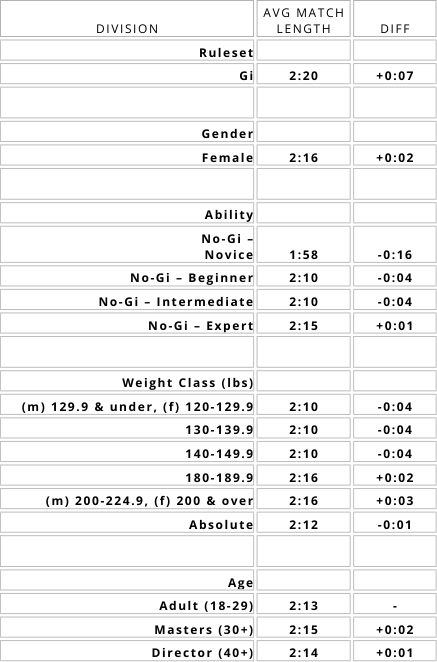
For the most part, all of the different influential divisions had submission matches that ended within 1-4 seconds of the average. Gi matches lasted a little longer (2:20, +7 seconds), and no-gi novice matches ended in submission 16 seconds faster on average (but also have 4% fewer submissions than average).
I your match is going to end in a submission, it has a good chance of being about two minutes and change, right?
Remember that this 2:13 time is an average. That means that there are roughly an equal number of matches that end at various times throughout the entirety of regulation time. For instance, if there are 10 matches that end at the 1:00 mark, and 10 that end at the 3:00 mark, the average would be 2 minutes.
The next step (one that I’m going to do in the future) is to look at the distribution over time for submissions. That might provide more insight as to submission match length.
How would this affect my training?
For one, you should be aware of how long regulation is for your matches, and be aware of any other rules that might kick in. If you train for 4 minute rounds, but are competing at a Grappling Industries event, you’re likely going to be gassed for that last minute. NAGA no-gi matches allow for overtime when there’s a tie, and they start as soon as regulation ends. If you’re expecting a 5 minute match but it’s only 4, you might hold back too much and not be as aggressive when you think you have more time than you do.
But if a submission takes 2 minutes on average, that could change your pacing and strategy, right? If you or your opponent doesn’t get the submission in that time, you can ride it out and go for the point win, correct?
Without looking at the distribution of the submissions across round time, it’s difficult to draw any conclusions about how you might adapt your training.
It’s something I’ll be doing in the future, and maybe that data will reveal something, but until then, I’d recommend continuing to train as if your rounds will all go to regulation, and in such a way that leaves enough gas in the tank if you need to go into OT.
In other words, keep doing lots of cardio.